
Elephant Intelligence: What Dolphins and Whales Reveal
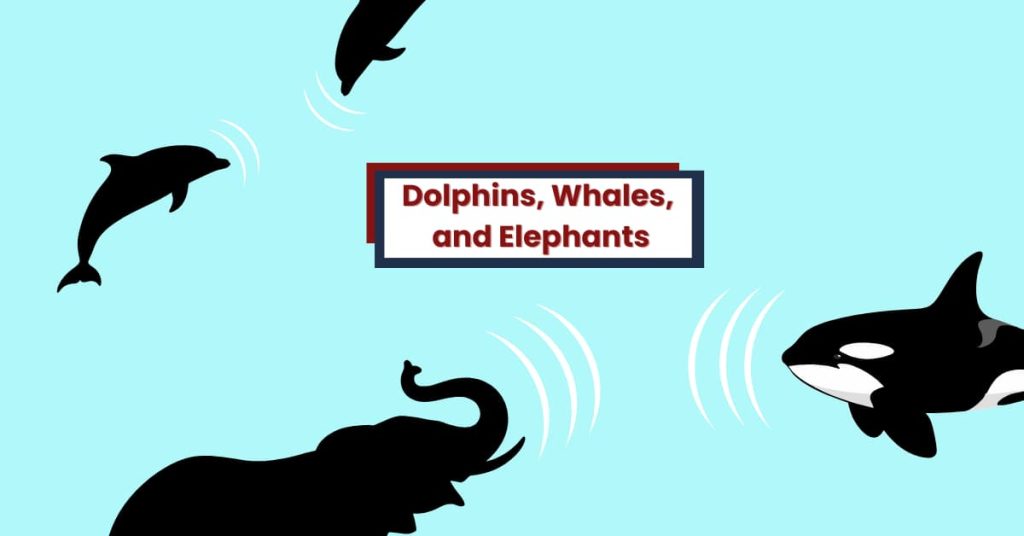
When researchers set out to study elephant intelligence, many begin with the cetaceans—and for good reason. Scientists have studied dolphins and whales far longer than elephants and modern research on their communication, language, and intelligence continues to reveal how similar their traits are to the largest land mammals, the elephants.
Ocean Souls
Ocean Souls is an award-winning PBS documentary that takes an intimate look at cetacean family structure, emotion, language, and social organization. What makes this film remarkable is just how deeply it documents the language of dolphins and whales—abilities scientists are now discovering is also shared by elephants. Dolphins call one another by unique, and individual names…so do elephants. Watch the full documentary on YouTube.
Secrets of the Whales
Produced by James Cameron and narrated by Sigourney Weaver, Secrets of the Whales is a four-part National Geographic series filmed over three years across 24 locations worldwide. Each episode focuses on a different species, revealing how whales pass down unique traditions, languages, and cultural knowledge from one generation to the next. It’s the same kind of matriarchal, memory-driven social structure researchers are now documenting in elephant herds. Available on Hulu and/or Disney+.
Fathom
Fathom follows two scientists on opposite sides of the world as they work to decode the complex language of humpback whales. The film reveals striking similarities between whales and elephants. Both species demonstrate vocal learning and socially share calls within their groups. They also share a highly developed frontal cortex responsible for memory and language learning including specialized spindle neurons that are linked to advanced information processing, social awareness, and emotional connection.
Additional Sources for Dolphins and Whales
Explore additional sources on dolphin and whale communication, intelligence, and language that informed the research behind Elephant Mountain. As scientists uncover more evidence of complex communication, learning, and social intelligence in elephants, research on whales and dolphins offers important parallels and insights.
- AppleTV. “Fathom – Official Trailer | Apple TV+” YouTube video, 2:36. April 22, 2021. https://www.youtube.com/watch?v=Y-Mmnk0LZLU
- Armstrong, Brian, and Andy Mitchell, directors, writers, and creators. Secrets of the Whales. Produced by James Cameron. Narrated by Sigourney Weaver. National Geographic. Disney+. April 22, 2021.
- Deecke, V. B., J.K.B. Ford, and P. Spong. “Dialect Change in Resident Killer Whales: Implications for Vocal Learning and Cultural Transmision.” Animal Behaviour 60 (April 4, 2000): 629-638.
- Ford, John K.B. “Vocal Traditions Among Resident Killer Whales (Orcinus orca) in Coastal Waters of British Columbia.” Canadian Journal of Zoology (June 1991): 1454-1483.
- Herman, Louis M. “Can Dolphins Understand Sentences?” JSTOR, ResearchGate (January 2009): 3-20.
- Hamilton, Philip, director and producer. Ocean Souls. Produced by Scott Wilson. Narrated by Flora Clark. Journeyman Pictures, May 16, 2020. https://www.journeyman.tv/film/8669
- Iacoboni, Marco. “Imitation, Empathy, and Mirror Neurons.” Annual Review of Psychology 60 (January 2009): 653-670.
- MacDonald, James. “The Cultural Differences in Humpback Whale Songs.” JSTOR Daily, October 3, 2019. https://daily.jstor.org/cultural-differences-humpback-whale-songs/
- McDonald, Mark A., Sarah L. Mesnick, and John A. Hildebrand. “Biogeographic Characterisation of Blue Whale Song Worldwide: Using Song to Identify Populations.” Journal of Cetacean Research and Management 8 (July 2005): 55-65.
- Miller, Patrick J.O., and David E. Bain. “Within-Pod Variation in the Sound Production of a Pod of Killer Whales, Orcinus orca.” Animal Behavior 60, Issue 5 (December 2000): 617-628.
- Miller, Patrick James O’Malley. “Maintaining Contact: Design and Use of Acoustic Signals in Killer Whales, Orcinus Orca.” PhD diss., Massachusetts Institute of Technology/Woods Hole Oceanographic Institution, 2000. https://apps.dtic.mil/sti/tr/pdf/ADA384341.pdf
- Mustill, Tom. How to Speak Whale: A Voyage into the Future of Animal Communication. New York: Grand Central Publishing, 2022.
- National Geographic. “Secrets of the Whales | Official Trailer | Disney+” YouTube video, 0:59. March 10, 2021. https://www.youtube.com/watch?v=xOySOlB78dM
- Payne, Katy. Silent Thunder. New York: Penguin Publishing Group, 1999.
- Payne, Katy, and Roger Payne, producers. Songs of the Humpback Whale. CRM Records, 1979.
- Prochazkova, Eliska, and Mariska E. Kret. “Connecting Minds and Sharing Emotions Through Mimicry: A Neurocognitive Model of Emotional Contagion.” Neuroscience and Behavioral Reviews 80 (2017): 99-114.
- Stromberg, Joseph. “Dolphins Can Remember Their Friends After Twenty Years Apart.” Smithsonian Magazine, August 6, 2013. https://www.smithsonianmag.com/science-nature/dolphins-can-remember-their-friends-after-twenty-years-apart-24490888/?itm_source=related-content&itm_medium=parsely-api
- Stromberg, Joseph. “Do Dolphins Use Whistles to Call Themselves by Unique Name?” Smithsonian Magazine, July 22, 2013. https://www.smithsonianmag.com/science-nature/do-dolphins-use-whistles-to-call-themselves-by-unique-names-16005708/?itm_source=related-content&itm_medium=parsely-api
- Xanthopoulos, Drew, director. Fathom. Produced by Megan Gilbride. Starring Dr. Michelle Fournet and Dr. Ellen Garland. AppleTV, June 25, 2021. https://tv.apple.com/us/movie/fathom/umc.cmc.5dba56sgwst50iuh5h9uqpdsq
- YouTube Movies and TV. Ocean Souls. Directed and produced by Philip Hamilton. Produced by Scott Wilson. Narrated by Flora Clark. YouTube film, 57:46. (2020). https://www.youtube.com/watch?v=AfSE51HVWbA
- Zandberg, L., Lachlan RF, Lamoni L., and Garland EC. “Global Cultural Evolutionary Model of Humpback Whale Song.” The Royal Society Publishing Journal, (May 29, 2021): 1-12.