

Key Figures in Elephant Mountain
Discover the fascinating people featured in the book Elephant Mountain, including elephant trainers, writers, and one of the first humans to be put on display at a zoo. Each of these individuals plays a pivotal role in the story. Learn more about each of them here.
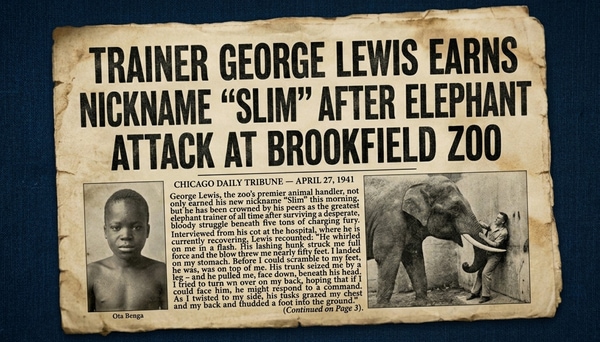
George “Slim” Lewis
A renowned elephant trainer, George “Slim” Lewis was deeply troubled by the public portrayal of Morgan Berry’s death. Slim was so passionate that he wrote an op-ed to The Oregonian, challenging the reported events.
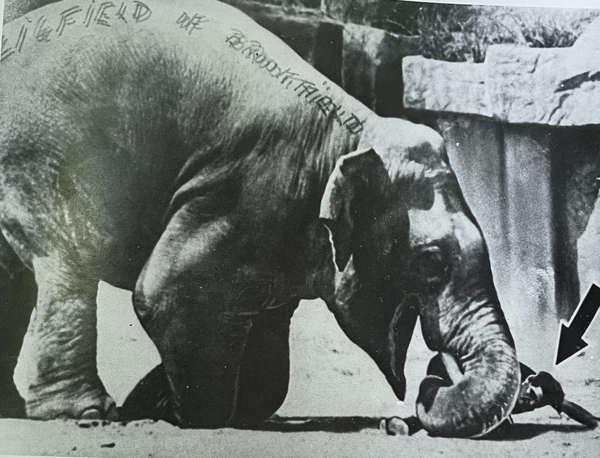
This archival photograph captures the moment George “Slim” Lewis survived a near-fatal attack by the bull elephant Ziggy at the Brookfield Zoo in 1941. While Lewis spent over a year in the hospital recovering from severe internal injuries and broken bones, he was considered the greatest elephant trainer of all time, largely due to this infamous photo. Ziggy spent the next ten years in total isolation, chained to a cement floor with less than three feet to move in any direction. Ironically, it was Lewis who came back to the Brookfield Zoo to let him outdoors for the first time since the attack. Ziggy’s life ended shortly after. Lewis’s book, I Loved Rogues: The Life of an Elephant Tramp was a bestseller and one of the most compelling books I’ve read about elephant men from that time.
- Alexander, Shana. The Astonishing Elephant. New York: Random House, 2000.
- Bordez, Claude, and Giovanni Iuliani. Dernier Tour de Piste. Paris: JCL, 2002.
- Lewis, George “Slim,” and Byron Fish. I Loved Rogues: The Life of an Elephant Tramp. Seattle: Superior Publishing Company, 1978.
- Lewis, George “Slim.” “Not Protective.” The Oregonian, July 16, 1979, p. 14.
Arthur Jones
A self-made billionaire and the creator of the Nautilus fortune, Arthur Jones owned elephants at his Florida preserve, known as Jumbolair. He captured hundreds of baby elephants from the wild, selling them to zoos and circuses across the United States. But Jones was far from unique—as Elephant Mountain reveals. A single determined man with money to spend and the right connections could take as many elephants as he wanted. And they all did. The fortunes that followed for those men were staggering.
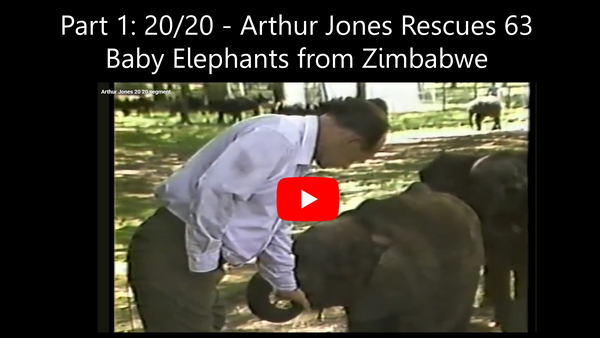
In 1984, ABC’s 20/20 interviewed Arthur Jones about his controversial transport of 63 wild elephants from Zimbabwe to his Florida compound, Jumbolair. This archival broadcast provides critical historical context for real-life events and timelines researched for Elephant Mountain. Download the video transcript here.
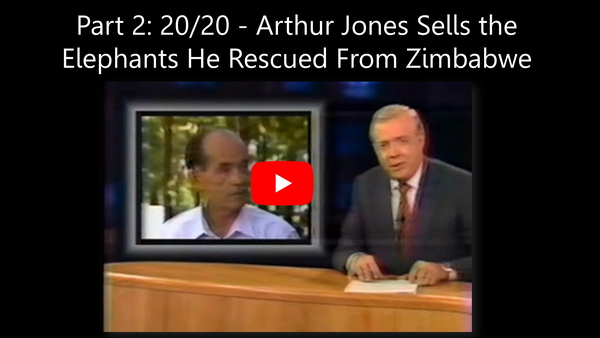
In 1987, ABC’s 20/20 returned to Florida to question Arthur Jones about the claims he made in his first interview—that he went to Zimbabwe to “save the elephants” when, in reality, most were sold to zoos and roadside circuses. As a result, several died. The follow-up investigation provides a sobering backdrop to the similar historical events and exploitation documented throughout Elephant Mountain. Download the video transcript here.
After Part 2 of “Save the Elephants” aired, Arthur Jones filed a defamation lawsuit against the producers of 20/20 and their parent company ABC, seeking over a billion dollars in damages. Jones claimed the interview made him appear “cruel to animals.” A Judge ruled in favor of ABC, and the case was ultimately dismissed.
- Cundiff, Rick, and Austin L. Miller. “Jumbolair Founder Arthur Jones Dies.” Ocala StarBanner (Ocala, Florida), August 29, 2007. https://www.ocala.com/story/news/2007/08/29/jumbolair-founder-arthur-jones-dies/31216563007/
- Hess, Jennie. “Inventor of Nautilus Exercises Right to Tell It How He Thinks.” The Chicago Tribune, September 7, 1986.
- Medina, Carlos. “Jumbolair Sells for $9.5 Million.” Ocala Gazette (Ocala, Florida), March 2, 2021.
- Moore, Randall Jay, and Christopher Munnion. Back to Africa. Johannesburg: Southern Book Publishers, 1989.
- Moore, Randall Jay, and Christopher Munnion. Elephants for Africa. Auckland Park, South Africa: Abu Publications, 2000.
- Pohlman, Katie. “Former Trump Attorney Cohen Has Tie to Marion County.” Ocala StarBanner (Ocala, Florida), August 31, 2018. https://www.ocala.com/story/news/local/2018/08/31/former-trump-attorney-cohen-has-tie-to-marion-county/10875187007/
- “McHenry County Elephant Linked to TB.” Chicago Tribune, August 11, 2021. https://www.chicagotribune.com/1997/02/06/mchenry-county-elephant-linked-to-tb/
- Schmidt, Michael, DVM. Jumbo Ghosts: The Dangerous Life of Elephants in the Zoo. Chicago: Xlibris Corp, 2002.
- “The Suffering is Over at the Hawthorn Corporation!” People for the Ethical Treatment of Animals, November 30, 2017. https://www.peta.org/blog/hideous-hawthorn-corporation-history/
- Thomas, Rob. “Feds Suspend License of Animal Compound.” Northwest Herald (Crystal Lake, Illinois), February 8, 1997.
- U.S. Department of Agriculture, Animal and Plant Health Inspection Service. Animal Care Inspection Report: The Hawthorn Corp, John F. Cuneo, Jr. License 33-C-053. April 10, 1997.
Ota Benga
Ota Benga, a Congolese man, was put on display at the Bronx Zoo in 1906 in the Monkey House. Just across the grounds, an elephant named Gunda was drawing headlines in the New York Times. His suffering sparked outrage, but Ota Benga’s never did. Both were held captive in the same place at the same moment in history. One could speak about what was done to him, while the other couldn’t. Their fates braided together in ways that say everything about what we were willing to see—and what we still refuse to.
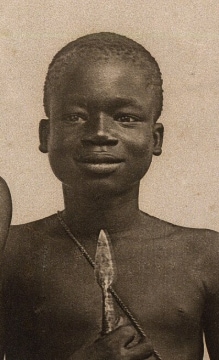
Ota was eventually released from the Bronx Zoo, where he was held in servitude. His captors promised to send him back to the Congo upon his release, but never did. With no money, no place to go, and recognized everywhere he went, young Ota took his own life.
- “Ota Benga Attacks Keeper.” The New York Times, September 25, 1906, p. 1.
- “Ota Benga Having a Fine Time: Zoo Visitor Finds No Reason for Protests Over Pygmy.” The New York Times, September 13, 1906, p. 6.
- “Ota Benga, Pygmy, Tired of America.” The New York Times, July 16, 1916, p. 12.
- “Wants to Buy the Pigmy: An Elderly French Woman Writes to Inquire About Ota Benga.” The New York Times, October 2, 1906. p. 9.
- “What is Ota Benga: One Who Has Explored Suggests that the Supposed Pigmy is a Hottenhot.” The New York Times, September 24, 1906, p. 7.
- Washington, Harriet A. “In Captivity: In the Early 1900s, Americans Flocked to See the ‘African Pygmy’.” The New York Times, June 7, 2015, p. A26.
Kari and Gary Johnson, Owners of Have Trunk Will Travel
Kari and Gary Johnson, owners of Have Trunk Will Travel (rebranded as The Preserve), were at the center of controversy involving the Oregon Zoo’s baby elephant Lily. The extent of elephant leasing contracts was largely unknown to the public until the Johnsons attempted to take ownership of Lily for their elephant promotion business, sparking widespread media attention. Videos later surfaced showing the mistreatment of elephants in their care, prompting public outcry. The Oregon Zoo initially denied the existence of an agreement with the Johnsons until the contract was leaked to the press. Backed into a corner, zoo officials were forced to admit it was all true and purchased the elephants for $400,000 to resolve the dispute.
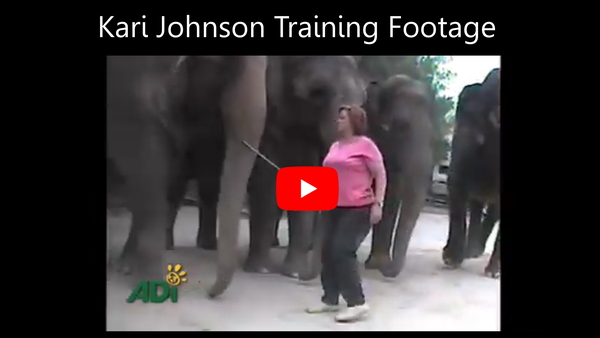
This footage, which circulated widely during the Oregon Zoo controversy, shows the training methods used by Kari Johnson (the daughter of the famous elephant trainer Smokey Jones) and her staff. What it reveals is far from unique to the Johnsons however, as Elephant Mountain documents through sources spanning generations of trainers. Elephants in captivity have been conditioned this way for decades, and it continues today. When California banned the use of the bullhook and electric prods against elephants—the tools visible throughout this footage—the Johnsons rebranded their business from Have Trunk Will Travel to The Preserve and quietly moved their operation to Fredericksburg, Texas, where no such ban exists. Viewer discretion is advised.
- Animal Defenders International. “Elephant Training at Have Trunk Will Travel.” YouTube video, 9:54. March 21, 2013. https://www.youtube.com/watch?v=L1AvNGWAkCY&list=PL8816EFB830EF16AC
- Cole, Jim. “Miller-Johnson Circus 1972.” Buckles Blog, March 31, 2008. https://bucklesw.blogspot.com/search?q=smokey
- Lewis, George “Slim,” and Byron Fish. I Loved Rogues: The Life of an Elephant Tramp. Seattle: Superior Publishing Company, 1978.
- Mesh, Aaron. “12 Mammals that Matter to the Oregon Zoo.” Willamette Week, May 28, 2014, pp. 12-19.
- Protect All Wildlife. “Animal Trainers Abuse at Have Trunk Will Travel.” YouTube video, 1:00. July 3, 2017. https://www.youtube.com/watch?v=jwB5xU66ODc
- Sheridan, Tom. “The Elephants Not in the Room: As Culture Shifts from Using the Creatures in Circuses and Elsewhere, Family’s Livelihood Uncertain.” The Orange County Register, May 15, 2015. https://www.ocregister.com/2015/05/15/the-elephants-not-in-the-room-as-culture-shifts-from-using-the-creatures-in-circuses-and-elsewhere-familys-livelihood-uncertain/
Shana Alexander
Author of several books, and a close friend of Morgan Berry, Shana Alexander was a trailblazing journalist. She was the first female editor of Life Magazine, and her political wit helped shape the early success of 60 Minutes where she appeared in the famous segment of the show, Point/Counterpoint, alongside James “Jack” Kilpatrick. Shana was also the first person to question the events surrounding Morgan Berry’s death on Elephant Mountain, and wrote about her concerns in The Astonishing Elephant.
- Alexander, Shana. “Belle’s Baby 225 Pounds and All Elephant.” Life Magazine, May 11, 1962, pp. 104-120.
- Alexander, Shana. “For the Love of Elephants: An Inquiry into the Violent Death of an Old Friend.” Life Magazine, March 1980, pp. 79-92.
- Alexander, Shana. The Astonishing Elephant. New York: Random House, 2000.
- Maberry, Matthew, Patricia Maberry, and Michelle Trappen. Packy & Me. Beaverton, Oregon: Maberry Press, 2011.
John Cuneo, Jr.
Heir to one of the largest fortunes in the United States, John Cuneo, Jr. owned the notorious Hawthorn Corp. After his marriage to Eloise Berchtold ended, he began leasing circus animals, including Tyke, the elephant who killed her trainer during a performance in Honolulu. Before his company was forced to shut down, Cuneo attempted to transport an elephant that had tested positive for tuberculosis to Puerto Rico, a case that revealed the first known strain capable of jumping from elephants to humans.