

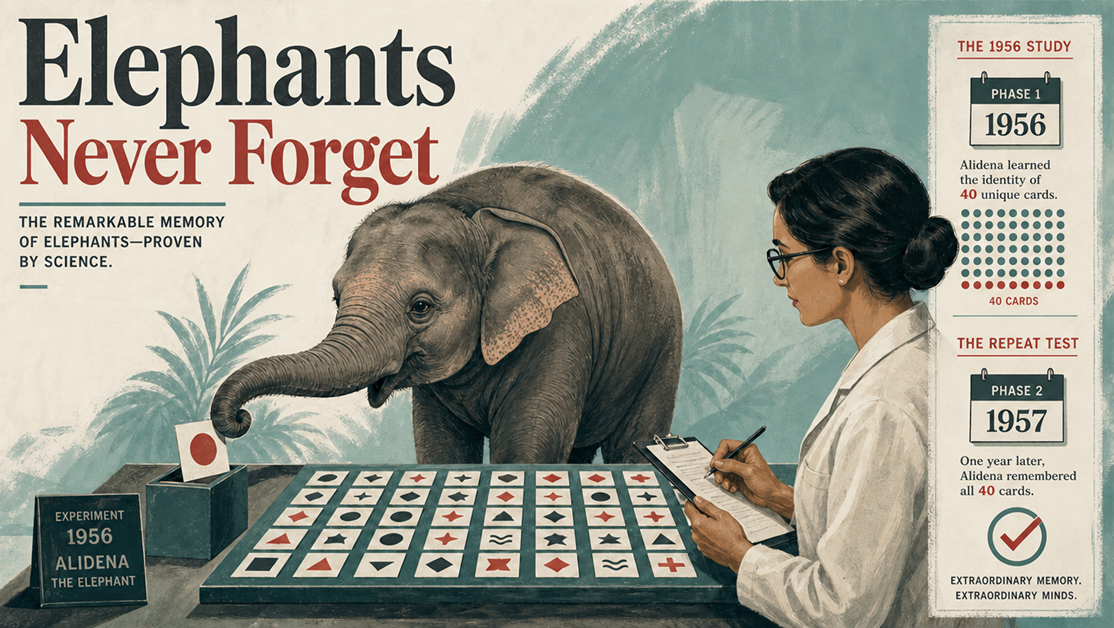
We have all heard the saying, “elephants never forget.” For most of us, it sounds like a charming bit of folklore or a line from a children’s book. But science revealed the incredible depth of elephant memory decades ago, and the knowledge never reached the general public.
In 1956 and 1957, Bernhard Rensch published research showing that one young elephant could learn, remember, and sort through an astonishing number of visual patterns long after she had last seen them. And yet, nearly seventy years later, people are still asking that same question: Is it true elephants never forget?
The short answer is…yes.
Or perhaps, if I were to answer like a scientist—it certainly appears that way.
Six Hundred Chances to Get It Wrong
A five-year-old Asian elephant named Alidena was introduced to the game of Memory. Researchers placed two small boxes before her, each covered with a card. One card in the pair was what they referred to as a “positive” card, meaning it led to a reward—a piece of bread. The other was a “negative” card, and no reward associated with it.
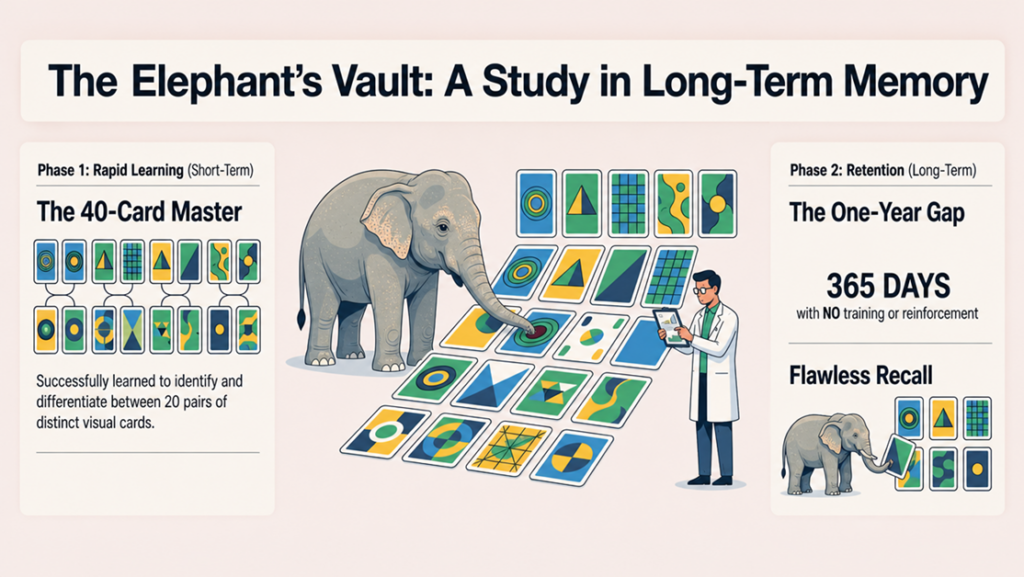
Researchers introduced twenty distinct pairs of cards. As Alidena learned to choose correctly from the simplest pairs, they increased the difficulty, moving from basic variations—wide stripes and thin stripes—to symbols and images with no obvious relationship to one another. As the visual patterns on the cards became more varied, Alidena learned the game.
And when scientists mixed a positive card among several unrelated negative ones, she still chose correctly, proving she understood the meaning of each individual pattern, not just the pattern of the one she’d most recently seen.
In a final test, Alidena faced all twenty pairs of cards at once in irregular order. Each set of twenty appeared before her thirty times, meaning she faced 600 choices over several hours. The researchers expected her to become tired, bored, distracted, or to simply stop playing the game.
Instead, she got even better at it.
Across the different pairs, she made correct choices 80 to 100 percent of the time. In many cases, she made only one mistake—or none at all. And toward the end of the test, her memory actually improved.
Alidena was not merely enduring a long afternoon of repetitive choices. She held forty separate images in her mind at once, sorting them correctly again and again and becoming even more accurate as the hours passed. She showed that elephants can build a large storehouse of information and retrieve the right piece when they need it.
The researchers ended the study at twenty pairs, though they believed Alidena—still just five years old—was capable of learning far more.
One Year Later
Then came the truly astonishing part.
A year passed with no training and no practice. Then the researchers returned with thirteen of the original twenty card pairs.
And Alidena remembered—Every. Single. One.
Across five hundred trials, she chose correctly between 73 and 100 percent of the time on twelve pairs. Even on the thirteenth, the one that gave her the most trouble, she was still right 67 percent of the time, making it also statistically significant.
Alidena had not only remembered how the game worked but retained the meaning behind the cards she had learned a year earlier—a striking glimpse into the remarkable elephant brain.
I cannot imagine a single human doing that, short of a photographic memory. I’ve played the game my whole life but could never recall the location of a single pair of cards after a week, let alone an entire year.
Elephants can live sixty to sixty-five years (on average), roughly as long as we do, which raises the question: what might she have accomplished with another decade, or even fifty more years, for her mind to develop?
Yet the real mystery of Alidena’s story isn’t whether she was able to remember forty cards. It is why a discovery so profound remained hidden for so long, while we have been left wondering about something scientists had revealed nearly seventy years ago: is it true that elephants never forget? Alidena had already given us the answer.
Want to explore elephant memory with your students? Try my Elephant Memory Task Cards, inspired by Alidena’s remarkable story.
About the Author

Debbie Ethell is an elephant scientist and educator. She is the author of The Will of Heaven, a book series exploring her life, her experiences with elephants, and the journey that shaped her work. Through her Teachers Pay Teachers store, Elephants in the Classroom, she creates elephant-based reading comprehension worksheets and curriculum that brings science to life for young students. Whether she’s writing books, developing educational resources, or sharing insight on her blog All Things Elephant, her goal is the same: to help people discover the remarkable lives of elephants through both story and science.
Sources:
* The elephant in this experiment was unnamed in the research, but I believe she was, in fact, Alidena, who was at the zoo in Münster, Germany, during the time this experiment was conducted.
Rensch, Bernhard. “Increase of Learning Capability with Increase of Brain-Size.” The American Naturalist 90, no. 851 (March-April 1956): 81-95.
Rensch, Bernhard. “The Intelligence of Elephants.” Scientific American, 196, no. 2 (February 1957): 44-49.