

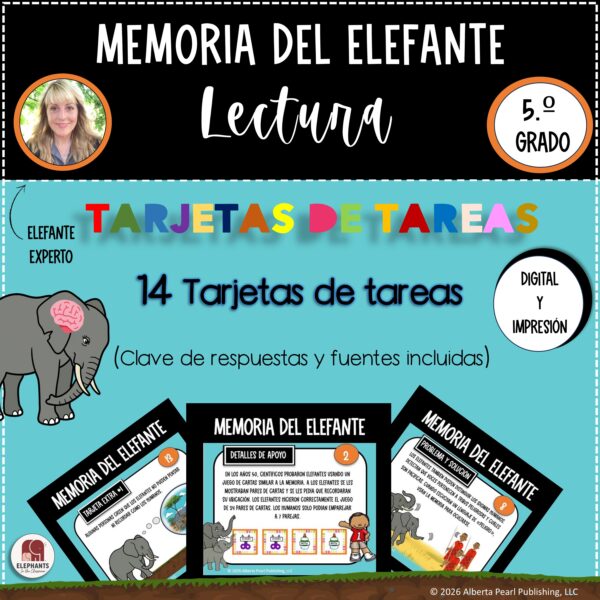
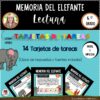
Written by an elephant scientist and author, these engaging Spanish reading task cards help students explore the extraordinary memory of elephants through informational texts and evidence-based science.
What makes this resource different?
Built around one of the animal kingdom's most intriguing questions—is it true that elephants never forget?—this resource explores fascinating scientific research on elephant memory. Students will discover how elephants performed in a memory card game, remembered the same sets of cards a year later, and demonstrated an ability to distinguish between human languages and sexes.
By combining actual elephant science with reading comprehension in Spanish, these task cards spark curiosity, build literacy skills, and bring science into your classroom in a memorable way.
What’s Included
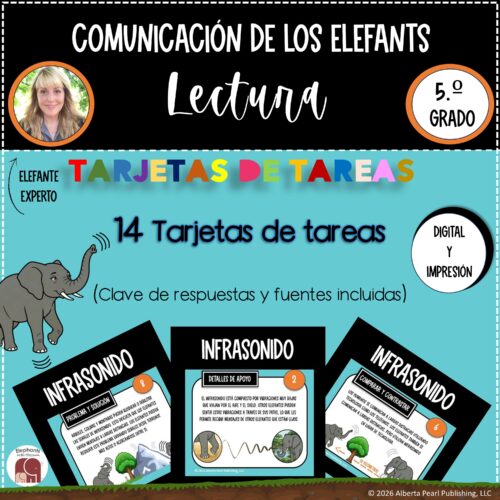
- 12 Core Task Cards
- 2 Bonus Extension Cards
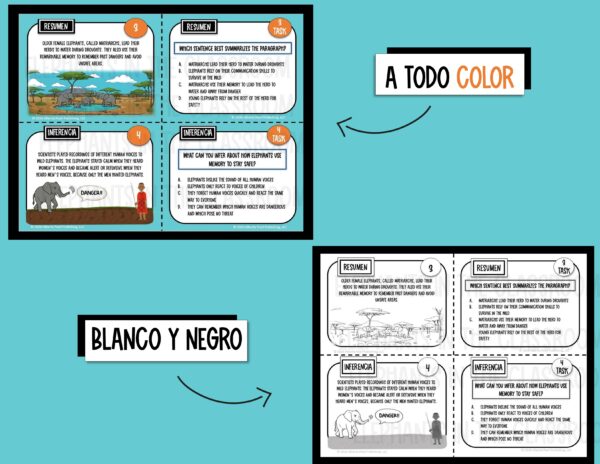
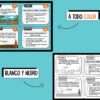
- Full-Color Reading Comprehension Exercises PDF Printer-Friendly
- Black & White Printer-Friendly PDF
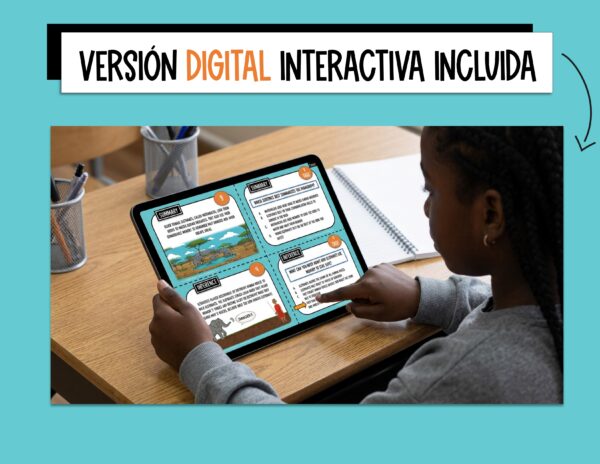
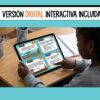
- Digital Google Slides Version
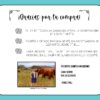
- Answer Key + Sources & References + Student Recording Sheets
- Teacher-Only Reference Sources
Perfect for
- Science-Integrated Reading Lessons
- Literacy Centers
- Informational Text Skill Practice (5th Grade)
- Early Finishers
- Test Prep for Reading Comprehension Standards
- Animal Research Units
Standards Alignment
Common Core State Standards
CCSSRI.5.1
Quote accurately from a text when explaining what the text says explicitly and when drawing inferences from the text.
CCSSRI.5.2
Determine two or more main ideas of a text and explain how they are supported by key details; summarize the text.
CCSSRI.5.3
Explain the relationships or interactions between two or more individuals, events, ideas, or concepts in a historical, scientific, or technical text based on specific information in the text.
CCSSRI.5.4
Determine the meaning of general academic and domain-specific words and phrases in a text relevant to a grade 5 topic or subject area.
CCSSRI.5.5
Compare and contrast the overall structure (e.g., chronology, comparison, cause/effect, problem/solution) of events, ideas, concepts, or information in two or more texts.
Texas TEKS
LA.5.6.A
Comprehension skills: listening, speaking, reading, writing, and thinking using multiple texts. The student uses metacognitive skills to both develop and deepen comprehension of increasingly complex texts. The student is expected to: establish purpose for reading assigned and self-selected texts;
LA.5.6.B
Comprehension skills: listening, speaking, reading, writing, and thinking using multiple texts. The student uses metacognitive skills to both develop and deepen comprehension of increasingly complex texts. The student is expected to: generate questions about text before, during, and after reading to deepen understanding and gain information;
LA.5.6.E
Comprehension skills: listening, speaking, reading, writing, and thinking using multiple texts. The student uses metacognitive skills to both develop and deepen comprehension of increasingly complex texts. The student is expected to: make connections to personal experiences, ideas in other texts, and society;
LA.5.6.F
Comprehension skills: listening, speaking, reading, writing, and thinking using multiple texts. The student uses metacognitive skills to both develop and deepen comprehension of increasingly complex texts. The student is expected to: make inferences and use evidence to support understanding;
LA.5.6.G
Comprehension skills: listening, speaking, reading, writing, and thinking using multiple texts. The student uses metacognitive skills to both develop and deepen comprehension of increasingly complex texts. The student is expected to: evaluate details read to determine key ideas;
LA.5.6.H
Comprehension skills: listening, speaking, reading, writing, and thinking using multiple texts. The student uses metacognitive skills to both develop and deepen comprehension of increasingly complex texts. The student is expected to: synthesize information to create new understanding; and
LA.5.7.B
Response skills: listening, speaking, reading, writing, and thinking using multiple texts. The student responds to an increasingly challenging variety of sources that are read, heard, or viewed. The student is expected to: write responses that demonstrate understanding of texts, including comparing and contrasting ideas across a variety of sources;
LA.5.7.D
Response skills: listening, speaking, reading, writing, and thinking using multiple texts. The student responds to an increasingly challenging variety of sources that are read, heard, or viewed. The student is expected to: retell, paraphrase, or summarize texts in ways that maintain meaning and logical order;
LA.5.7.F
Response skills: listening, speaking, reading, writing, and thinking using multiple texts. The student responds to an increasingly challenging variety of sources that are read, heard, or viewed. The student is expected to: respond using newly acquired vocabulary as appropriate; and
LA.5.7.G
Response skills: listening, speaking, reading, writing, and thinking using multiple texts. The student responds to an increasingly challenging variety of sources that are read, heard, or viewed. The student is expected to: discuss specific ideas in the text that are important to the meaning.
Virginia SOL
R.5.6.a
The student will read and demonstrate comprehension of nonfiction texts. Use text features such as type, headings, and graphics, to predict and categorize information.
R.5.6.b
The student will read and demonstrate comprehension of nonfiction texts. Skim materials to develop a general overview of content and to locate specific information.
R.5.6.c
The student will read and demonstrate comprehension of nonfiction texts. Identify the main idea.
R.5.6.d
The student will read and demonstrate comprehension of nonfiction texts. Summarize supporting details.
R.5.6.e
The student will read and demonstrate comprehension of nonfiction texts. Identify organizational pattern(s).
R.5.6.f
The student will read and demonstrate comprehension of nonfiction texts. Identify transitional words and phrases that signal an author’s organizational pattern.
R.5.6.g
The student will read and demonstrate comprehension of nonfiction texts. Locate information from the text to support opinions, inferences, and conclusions.
R.5.6.h
The student will read and demonstrate comprehension of nonfiction texts. Identify cause and effect relationships.
R.5.6.j
The student will read and demonstrate comprehension of nonfiction texts. Compare and contrast details and ideas within and between texts.
Blog: Is It True Elephants Never Forget?
Reviews
There are no reviews yet.